
A-B-C supply chain transactions – simplification of VAT regulations
July 27, 2020

Starting July 2020, tax codes regarding VAT on A-B-C supply chain transactions have been simplified. The change is lifting the obligation of the middleman to register for VAT abroad. However, the simplification specifically concerns transactions, where three parties are involved.
A-B-C supply chain transactions are a subset of intra-community chain transactions. They always involve at three business operators based in three different EU Member States. In such a transaction, the middleman – (EU 2), buys goods from operation EU 1, often a manufacturer. Next EU 2 sells them off to operator EU 3. Then, we observe two transactions, however, only one transport occurs – directly from EU 1 to EU 3.
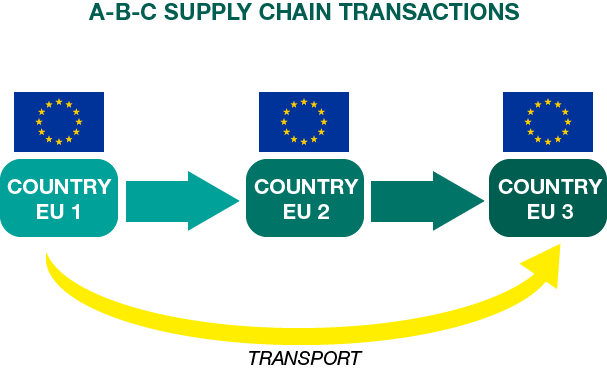
New regulations on settling intra-community chain transactions
As of July 2020, in transactions where EU 2 acts as a middleman, 0% VAT rate is to be applied on EU 2. It takes place only if transport of goods is organised directly from country of operator EU 1 to country of operator EU 3. Operator EU 3 issues an invoice to EU 2 on intra-community supply of goods. EU 2 registers the transaction as intra-community acquisition of goods from EU 1, and as intra-community supply of goods to EU 3. Then, EU 3 registers the transaction as intra-community acquisition of goods. Which operator acts of organiser of the transport is unimportant. Even if the transport of goods is organised by EU 3, business operator EU 2 still acts as middleman between EU 1 and EU 3. EU 3 allows EU 3 to acquire goods. As such, in A-B-C supply chain transactions it is EU 3 – the buyer – who is obligated to settle acquisition of goods at the domestic VAT rate applied in their country of registration.
Eligibility criteria for simplified A-B-C supply chain transactions
In order to be eligible for simplified VAT settlement, four requirements based in art. 135 sec. 1 (4) of the VAT Act need to have been met:
- Supply of goods by EU 2 to see needs to take place immediately following acquisition of goods from EU 1 by EU 2. EU 2 is to prove this by using the same VAT ID number in both transactions with EU 1 and with EU 3.
- Business operator EU 2 needs NOT to be registered for VAT in the country to which the final supply of goods with take place. This can be proven by EU 2 using a VAT ID number from a EU Member State. However, the number must be different than EU 3.
- EU 3 – the final buyer – settles the transaction using a VAT number from the state, which is the final destination of the transport of goods. Ex. goods are transported to a Polish operator using a Polish VAT ID number.
- EU 2 has ascribed EU 3 as the party obligated to settle VAT. It must be settled on acquisition of commodities under regulation on simplified intra-community chain transactions. The middleman informs the buyer on participation in a chain transaction. The middle man annotates that the recipient of the commodities is to settle VAT on acquisition of goods.
In conclusion, these changes will simplify operations for middleman companies. It allows them to trade and expand without the need to register for VAT in each state. The changes will render application for VAT returns not necessary.
Author: Justyna Rembikowska
Proofreading and SEO analysis: Dawid Zawolski
Tags 0% VAT rate chain transactions, A-B-C supply chain transactions, intra-community chain transactions


