
Chain transactions – examples
April 17, 2019
When we’re buying something, we rarely think about the way it’s been through before a final consumer – us – received said thing. In case of companies however, it is of most importance for this path to be precisely defined. After thorough analysis of purchase and transport documents it may become clear, that we are the last link in chain transaction.
According to art. 7 §8 of law of service and commodity tax(hereinafter referred to as VAT law) the chain transactions is a type of transaction which requires a few contractors to send a commodity from the last to the first party. So it wouldn’t be wrong to say, that it’s a delivery of the same commodity, and every party involved in a transaction recognizes this delivery for the next link in chain.
Chain transactions can be divided into two types:
- national – every party involved in a transaction is localized within a territory of the same country and a commodity is being moved exclusively within the borders of said country
- international – parties involved in a transaction are localized in two or more different countries and a commodity is being moved between them
Chain transaction – example 1
The diagram below is a depiction of national chain transaction:
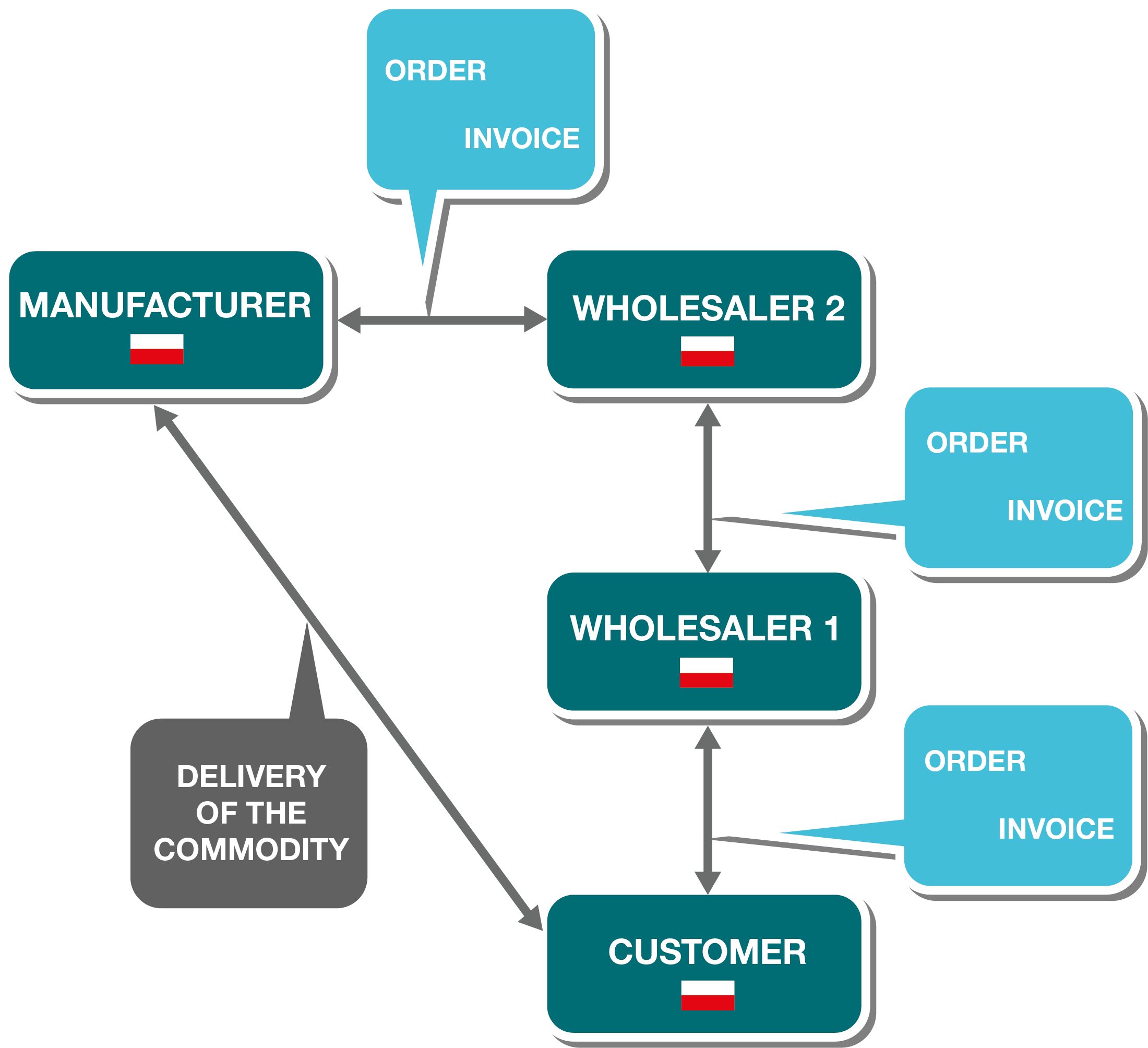
The Customer orders a commodity in Wholesale 1. Wholesale 1 however, doesn’t have commodity being ordered, so it turns to Wholesale 2 for help. Wholesale 2 also doesn’t have said commodity, so it contacts the Manufacturer directly and orders a commodity from them. Manufacturer organizes transport and a commodity is being delivered directly to the Customer.
In an example above the physical delivery occurs between a producent and a customer. According to a VAT law(art. 7 §1) however, we observe three deliveries, because every party involved is in possession of a subject being ordered in the same way as the owner, despite never having an object physically(excluding customer and manufacturer). In effect, every supplier is obliged to invoice and settle due VAT tax, and every customer has a right to deduct VAT tax charged during purchase.
In case of international chain transactions, when a commodity is being moved between different countries, it is important to set a delivery responsible for an actual transport of a commodity. In other words – a movable transaction.
Art. 22 §2 of VAT law states, that in case of a delivery of the same commodity being carried out by multiple parties in a way, that the first party delivers a commodity directly to the last customer in queue, the shipment or transport are assigned to only one delivery. In case a commodity is being physically moved to the link responsible for delivering it to the customer, the transaction for this link is to be considered movable. The transport of commodity can be assigned to the delivery to the customer only if this is stated in terms of delivery(INCOTERMS 2000, INCOTERMS 2010, RAFTD etc.).
Analyzing shipping documents we have to state which subject is most involved in organisation(both from formal and technical perspective) of delivery or transport of commodity, who:
- will bear majority or all costs of transport and insurance during delivery
- is responsible for safely delivering the commodity to the customer
- has an ability to control the commodity in a country in which the process begins
After defining proper delivery as movable transaction, all other are to be considered “non-movable transactions”. Therefore art. 22 §3 of VAT law states, that every delivery preceding a movable transaction are taxed in a country in which the transport or delivery began, every delivery after a movable transaction however, are taxed in a country in which the transport or delivery ends.
Thanks to assignment of “movable” status to one transaction every subject knows how to settle a tax and which delivery is to be referred to as intra-community supply(ICS) and commodity export. Therefore every delivery done before a movable transaction will be taxed in country of delivery. Every delivery after a movable transaction will be taxed in a country of final destination. The transaction to which commodity transport will be assigned will have characteristics of intra-community supply or export and intra-community acquisition (ICA) or import of commodity.
Chain transaction – example 2
The diagram below depicts an international chain transaction. In this case contractors are registered in two different countries.
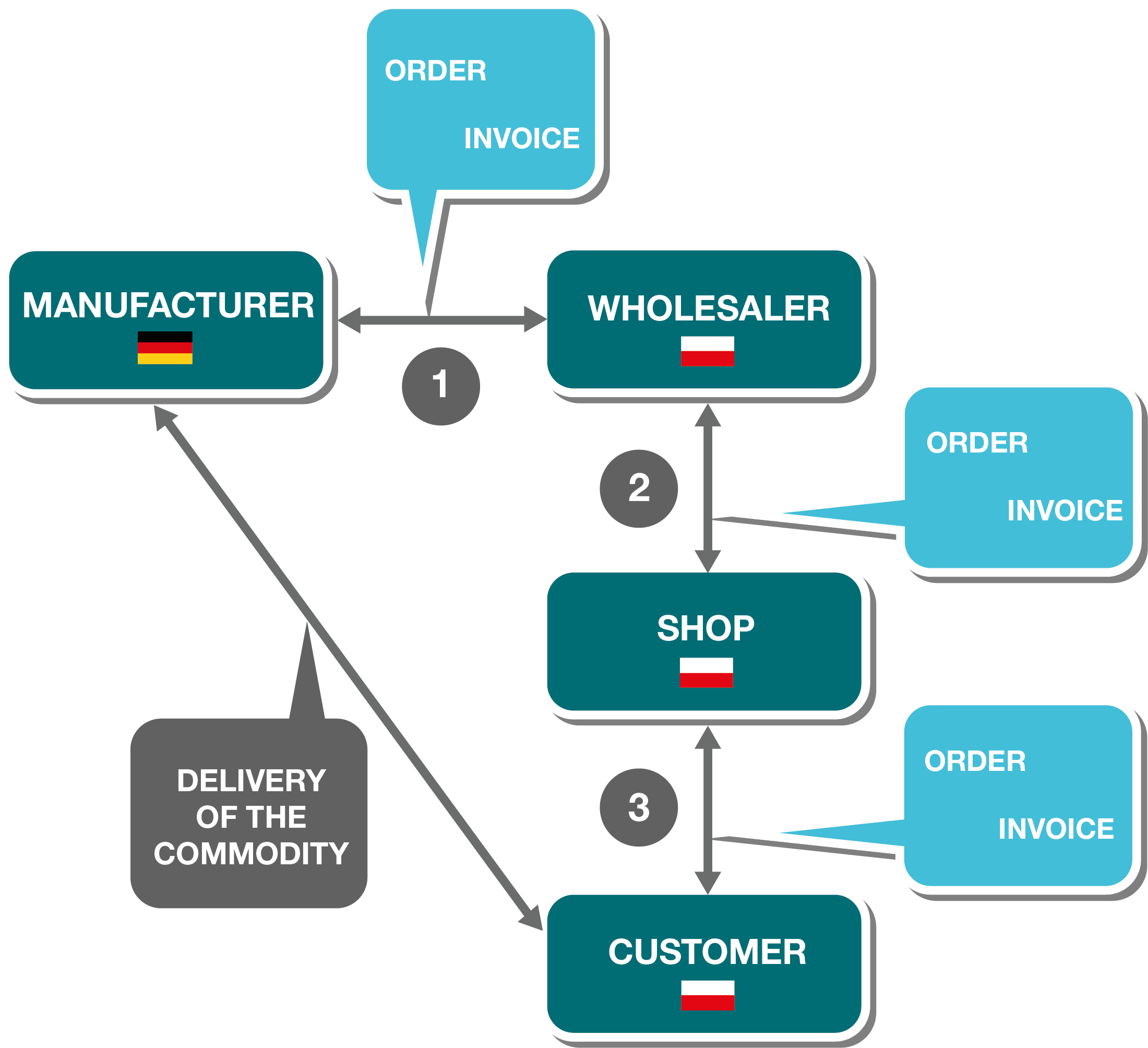
Customer present and registered in Poland places an order in a Shop, which is registered and placed in Poland as well. Shop doesn’t have a commodity in question, so it turns for help to Wholesale 1(registered in Poland), which doesn’t have a commodity as well, so it orders it from Manufacturer. Manufacturer is placed and registered in Germany. Therefore we have three subjects using NIP with PL prefix and one using DE prefix.
Commodity is being delivered from Manufacturer directly to the Customer.
Let’s analyze a few possible variants of defining a movable transaction and settling an exemplary transaction:
1. Transaction 1 is a movable transaction, 2 and 3 are non-movable.
- Manufacturer invoices a purchase with NIP with DE prefix for a PL Wholesale, in records it’s registered as an ICS
- PL Wholesale registers a purchase from DE Manufacurer as ICA, invoices it as national purchase for PL Shop
- PL Shop registers a national purchase from PL Wholesale in VAT records and a national sale for PL Customer
- PL Customer shows national purchase from PL Shop
2. Transaction 2 is a movable transaction, 1 and 3 are non-movable.
- Manufacturer invoices a purchase with NIP with DE prefix for a Wholesale with DE NIP, in records it’s registered as a national purchase. Therefore a Wholesale from Poland has to register in Germany for VAT purposes
- DE Wholesale registers a purchase from DE Manufacturer as a national purchase on German territory and invoices it as national sale for PL Shop and shows it as ICS
- PL Shop shows ICA transaction with DE Wholesale in VAT records and national sale for PL Customer
- PL Customer shows a national purchase from PL Shop
3. Transaction 3 is movable, 1 and 2 are non-movable
- Manufacturer invoices a purchase with NIP with DE prefix for a Wholesale with DE NIP, in records it’s registered as a national purchase. Therefore a Wholesale from Poland has to register in Germany for VAT purposes
- DE Wholesale registers a purchase from DE Manufacturer as a national purchase on German territory and invoices it as a national sale for Shop with DE NIP. In such a case, a polish Shop has to register in Germany for VAT purposes
- DE Shop shows national purchase on German territory from DE Wholesale in VAT records, invoices a sale for PL Customer and shows it as ICA
- PL Customer shows ICA as a purchase from DE shop
Chain transaction – example 3
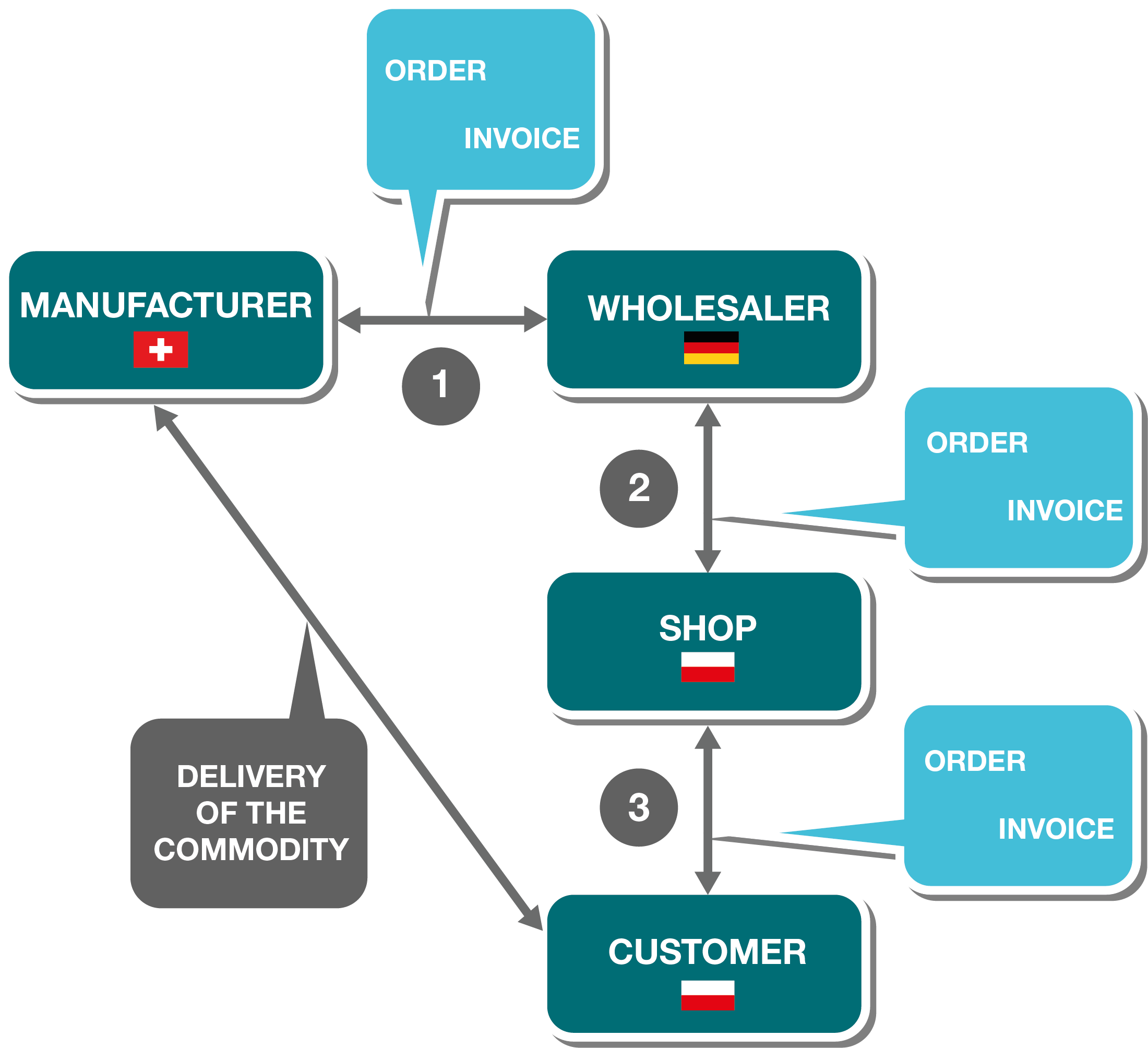
Let’s have a look at another scheme depicting an international chain transaction. In this case the contractors are registered in three different countries.
Customer placed and registered in Poland places an order in a Shop, registered and placed in Poland as well. Shop doesn’t have a commodity in question, so it turns to Wholesale (registered in Germany), which doesn’t have it too. Wholesale orders it from Manufacturer. Manufacturer is placed and registered in Switzerland. We have two subjects with PL NIP prefix, one with DE and one with CH.
Commodity is being transported from Manufacturer directly to Customer in Poland.
Just as we did before, let’s analyze a few possible variants of spotting and settling a movable transaction:
1. Transaction 1 is movable, 2 and 3 are non-movable:
- Manufacturer invoices a purchase with NIP with CH prefix for a Wholesale placed in Germany, but commodity is being transported to Poland, so a Wholesale from Germany has to register in Poland(sale invoice between CH and PL). Wholesale shows it as export in registry.
- German Wholesale with PL prefix registers a purchase from CH Manufacturer as commodity import, invoices it as national sale to PL Shop.
- PL Shop registers a national purchase from Wholesale(PL NIP) in VAT records and a national sale for PL Customer
- PL Customer shows national purchase from PL Shop
2. Transaction 2 is movable, 1 and 3 are non-movable:
- Manufacturer invoices a purchase with NIP with CH prefix for a CH Wholesale, invoices it as a national sale, a Wholesale from Germany has to register in Switzerland for VAT purposes.
- CH Wholesale registers a purchase from CH Manufacturer as national purchase, invoices it as an export to PL Shop.
- PL Shop registers an import from German Wholesale registered in CH in VAT records and a national sale for PL Customer
- PL Customer shows commodity import as a purchase from PL Shop
3. Transaction 3 is movable, 1 and 2 are non-movable:
- Manufacturer invoices a purchase with NIP with CH prefix for a CH Wholesale, invoices it as a national sale, a Wholesale from Germany has to register in Switzerland for VAT purposes.
- CH Wholesale registers a purchase from CH Manufacturer as national purchase and invoices it as a national sale for polish Shop with CH prefix(because Shop has to register in Switzerland for VAT purposes)
- CH Shop shows a national purchase on Swiss territory from CH Wholesale in VAT records and invoices a sale for PL Customer, showing it in the records as an export.
- PL Customer shows an import as a purchase from CH Shop

Summing up, the most important things in correct chain transactions description are:
- describing the chains’ structure(graphically for best results)
- making sure if the commodity is being transported or sent. If so, which countries are taking part in the process?
- defining which transaction is movable and assigning ICS-ICA or export-import status.
Tags chain transactions, movable transaction, non-movable transaction


