
Settling profit and loss statements of limited companies – COVID-19
August 18, 2020

On March 31st 2020, the Ministry of Finance has issued a decree, by which the deadlines for settling profit and loss statements of limited companies have been moved by three months. This article covers the protocols, which we should follow when approaching annual statements. We explain the most important aspects, to which we should pay close attention.
Annual Partner Meetings in 2020
According to art. 231(1) of the Code of Commercial Companies, after the extention of deadlines for settling profit and loss statements of limited companies, the companies are to call an Annual Partner Meeting within nine months of the end of the fiscal year. Six months as usual, based on the CCC, plus three months due to the “Covid” decree.
Evaluation of annual financial statements and management reports
During the annual parter meeting management reports on company activities and financial statements for a given fiscal year are to be evaluated and approved. Once these are approved, we move the profits or losses – the financial result of the company – from the “Financial result’ account onto the “Settlement of financial result” in the books. The settling the profit and loss statement (financial result) of limited companies follows this graph:
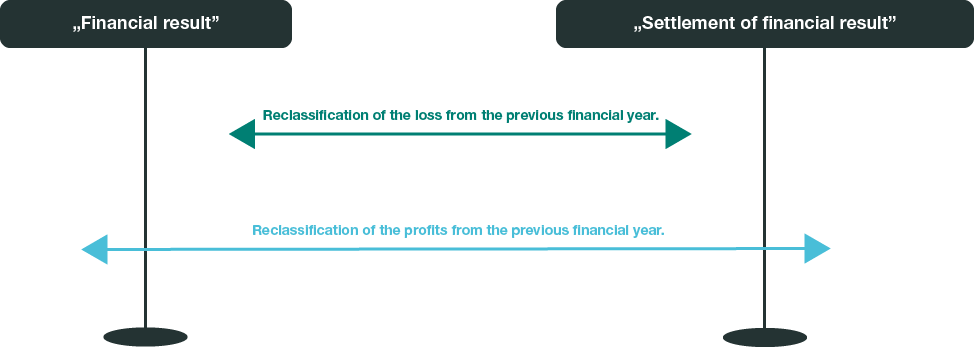
The financial result of a company will remain on this account as unappropriated profits or untreated losses from previous years. It does so until a resolution on appropriation of profit or treatment of loss is adopted by the partner meeting.
Directives of the CCC imply that appropriation of profit or treatment of loss for the given fiscal year needs not be carried out on the same day as the approval of financial statements. Additionally, The Accounting Act does not specify a timeframe for these either. However, the regulations do specify that appropriation of profit or treatment of loss cannot be carried out without the financial statements having been approved.
Settlement of financial results of Ltd. and Inc. companies
Settlement of financial results of a Ltd. or an Inc. is comprised of the gross financial result reduced by the manditory charges on the financial result. In limited liability companies, settlement of financial results is carried out in accordance with resolutions made during annual partner meetings. In incorporated companies, it is carried out based on resolutions by the general meeting of shareholders.
Appropriation of profit or treatment of loss in Inc. companies
Decisions regarding appropriation of profit or treatment of loss in an incorporated company are made at shareholders’ meetings. These decisions must be unambiguous regarding the means of appropriating the profit/treating the loss. When manging the financial result, partners/shareholders should be aware of regulations laid down in Articles of Assosiation. Important are also regulations in the CCC. These point to procedures, which are to be implemented when adpoting resolutions, and specify the amounts to be appropriated.
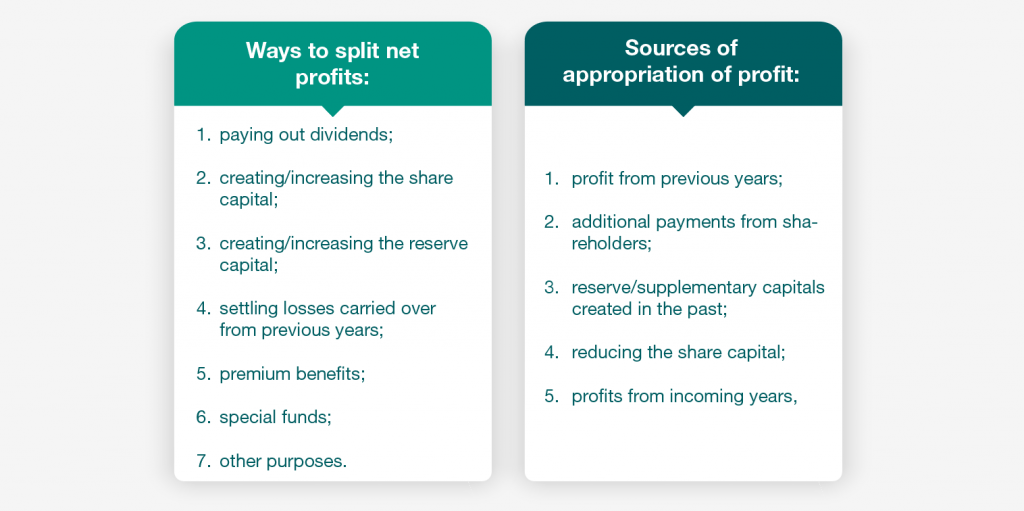
When managing the financial result of an incorporated company, most commonly one of four decisions is made:
- to pay out dividends
- to increase the share capital
- to create/increase the reserve capital or the supplementary capital
- to settle losses carried over from previous years
In this part of the article we will cover the regulations and tax obligations associated with these four decisions.
Paying out dividends
Dividend income, received by natual persons and legal entities, is liable for income tax at 19% rate. Exceptions to this are specified in Art. 22(4) and Art. 26(1a) of the Corporate Income Tax Act. A company paying out dividends is obligated to collect flat-rate income tax on the dividends, and to settle it with the Tax Office.
Increasing the share capital
Increasing share capital using company profits is regarded as income from share in profits of legal persons for the shareholders. The unit, who’s share capital is to be increased, collects income tax at flat rate of 19%. Increase of share capital is viewed as annexation of contract within the company. Thus, it is liable for tax on civil law transactions (TCLT). This tax, similarily to income tax, needs to be settled with with Tax Office by either the 7th day of the month (for natural persons) or the 20th day of the month (for legal entities).
Increasing the reserve capital/supplementary capital
Partners can opt to use the net profits to increase:
- the supplementary capital, ex. for coverage of future losses
- the reserve capital of the company, ex. for financing future investments
Based on the CCC, incorporated companies are mandated to set aside at least 8% of annual profits as supplimentary capital. Once a company as gathered one third of their share capital as supplementary capital, they can sease to contribute. Limited liability companies are not mandated to do so, yet such regulations can be included in their Articles of Association.
Opposite to increasing share capital, increasing reserve or supplementary capital is tax-exempt. A company can decide to use its reserve or supplementary capital to pay out dividends futher in the future. When it does so, the income will become liable for income tax at the 19% flat-rate.
Treatment of previous losses
A company can use profits to cover losses accumulated over the previous fiscal years. It is crucial to remember that if the losses of an Ltd. company exceed the sum of supplementary capital, reserve capital and half of share capital, a resolution on continuing operations needs to be adopeted. In the case of Inc. companies, this amount is equal to one third of the company’s share capital.
Reserve capital in incorporated companies can also be used to create funds for covering expenses and losses in specific areas. However, these need to abide by the Art. 396(4) of the CCC.
Is supplementary capital manditory?
Limited liability companies are not obligated to create supplementary and reserve capitals. They can be created if companies wish to, and can be utilised to subsidise profits. However, incorporated companies are mandated to create suppementary capital.
According to Art. 396(1) of the CCC, Inc. companies are obligated to create supplementary capital reserves for purposes of coverage of losses. At least 8% of profits for a given fiscal year needs to be transfered towards supplementary capital until it reaches one third of the share capital of the company. Once this is achieved, further contributions are voluntary.
Additionally, the Articles of Association of a given company can specify the profit that can be payed out to shareholders. In Inc. companies, profits previously allocated towards supplementary capital can be re-allocated towards paying out dividends, in accordance with Art. 396(5) of the CCC. However, an amount equal to one third of company’s share capital needs to remain in the supplementary capital. The purpose is to cover the loss.
Appropriation of profit
Therefore, it is crucial to remember, that the amount that can be split between partners/shareholders canot exceed the profits for the given fiscal year, increased by unappropriated profits from previous years and by amounts transfered out of supplementary/reserve capital which could be used to pay out dividends.
This amount is then to be reduced by untreated losses, by own shares/contributions, and by amounts which, according to Art. 192 and Art. 348(1) of the CCC) are to be transfered towards supplementary/reserve capital.
Author: Agnieszka Siwa-Kogut
Tags reclassification of the loss, settling losses in a limited company, share and reserve capital, split profits in a limited company


